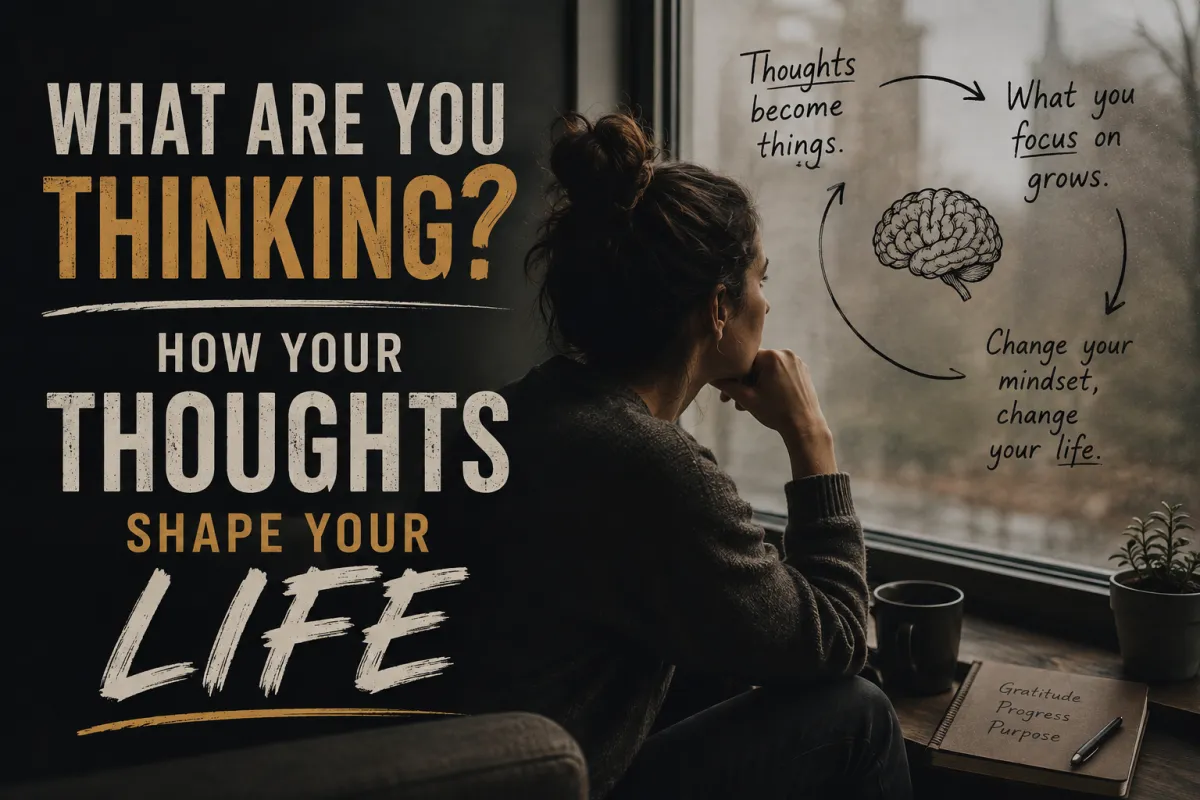
How your thoughts shape your life
What Are You Thinking? How Your Thoughts Shape Your Life
What are you thinking about right now?
Seriously.
What has been running through your head today?
Are you thinking about what’s going right—or everything that’s going wrong?
Are you replaying something someone said to you? Beating yourself up over a mistake? Worrying about something that hasn’t even happened yet?
Because here’s what I want you to understand:
You don’t become what you want. You become what you repeatedly think about.
Your thoughts are creating your life.
Not because thinking something magically makes it appear, but because your thoughts change how you feel. How you feel changes how you behave. How you behave changes the choices you make. And those choices eventually become your life.
Most of us just don’t realize how often we’re doing it.
Your Brain Is Always Listening
Someone cuts you off in traffic.
For a few seconds, you’re irritated. That part is normal.
But then what happens?
You replay it.
What an idiot.
Did you see what that guy did?
You get to work and tell someone about it. Then you tell someone else. Every time you tell the story, you get irritated all over again.
The actual event lasted five seconds.
You made it last two hours.
The person who cut you off didn’t ruin your morning.
Your thoughts about what happened did.
And we do this all the time.
We replay arguments. We rehearse things we wish we would have said. We worry about things that haven't happened. We tell ourselves stories about what other people meant.
Then we experience the emotions created by the story we keep telling ourselves.
That’s why one of the most powerful questions you can ask yourself is:
What am I choosing to focus on right now?
Because whatever you consistently focus on, you will eventually experience more of.
The Thought Loop
I teach something I call the Thought Loop.
It works like this:
Thought → Behavior → Choices → Experiences → Emotions → Thoughts
And then the whole thing starts over again.
Imagine that your starting thought is:
I’m not good enough.
That thought changes the way you show up.
Maybe you don't apply for the opportunity.
Maybe you stay quiet when you have something valuable to say.
Maybe you don't start the business.
Maybe you quit when something gets hard because somewhere inside you, you already believe you aren't capable.
Those behaviors lead to choices.
Those choices create experiences.
And eventually you look at those experiences and say:
See? I knew I wasn't good enough.
Now you've created evidence for the thought you started with.
But here's the part I love:
The loop works both ways.
Change the thought and you can begin changing everything that follows it.
What if instead of:
I can't do this.
You started with:
I don't know how to do this yet, but I can figure it out.
Now you show up differently.
You ask the question.
You try.
You learn.
You make a different choice.
That choice creates a different experience.
And eventually you start collecting evidence for a completely different belief about yourself.
That is how we change.
Gratitude Changes What You See
Someone broke into my car recently and stole some valuable things.
Was I happy about it?
Of course not.
But one of my first thoughts was:
I'm grateful they didn't break the window.
That might sound strange.
Why would I look for something good when something bad just happened?
Because I have trained myself to.
There was a time in my life when that would not have been my response. I would have focused on everything that was wrong. I would have been angry. I would have replayed it. I probably would have told everyone about the horrible thing that happened to me.
And I would have continued experiencing that event long after it was over.
Gratitude doesn't mean pretending bad things don't happen.
Gratitude means refusing to let the bad thing become the only thing you can see.
There is almost always something you can be grateful for.
Sometimes it's huge.
Sometimes it's simply:
At least they didn't break the window.
The more you practice looking for what is good, the better you become at finding it.
And the opposite is also true.
If you constantly look for what's wrong, your brain will get really good at finding that too.
You are training your brain every single day.
The question is: What are you training it to look for?
Stop Bullying Yourself
I had a moment recently when I was driving after a stressful interaction.
I caught myself thinking some pretty terrible things about myself.
And suddenly I realized:
I was bullying myself.
If another person talked to me the way I was talking to myself, I wouldn't tolerate it.
Yet there I was doing it to myself.
So, I said the thoughts out loud.
And then I changed them.
Instead of:
I'm so stupid.
I said:
I'm not stupid. I'm learning.
Instead of:
I should already know this.
I reminded myself:
I'm not where I want to be yet, but I'm getting better every day.
That doesn't mean lying to yourself.
If you made a mistake, acknowledge the mistake.
If you screwed something up, own it.
But there is a huge difference between:
I made a bad decision.
and
I am stupid.
One gives you something you can improve.
The other turns the mistake into your identity.
Talk to yourself like someone you are responsible for leading.
Because you are.
Your Brain Has Ruts
Think about a tractor driving through a muddy field.
The first time it drives through, it leaves tracks.
Drive that same path again and the tracks get deeper.
Again.
Deeper.
Again.
Eventually those tracks become ruts, and the tires naturally want to fall right back into them.
Your thoughts work the same way.
If you've spent years thinking:
Nothing ever works out for me.
I'm not good enough.
People always disappoint me.
I can't do this.
Those thoughts have ruts.
That's why changing the way you think can feel uncomfortable at first.
The new thought doesn't feel natural yet.
Your brain wants to fall back into the old rut.
Not because the old thought is true.
Because the old thought is familiar.
So, you have to intentionally create a new path.
Catch the thought.
Interrupt it.
Replace it.
Repeat.
Again.
Again.
Again.
Until one day the new path becomes easier than the old one.
That's how I changed my life.
Not in one giant moment.
Through thousands of tiny decisions to think differently, respond differently and show up differently.
You Have to Learn to Like Yourself
I once learned something about successful people that really stuck with me.
One of the things many of them had in common was incredibly simple:
They liked themselves.
Not arrogance.
Not believing they were better than everyone else.
They respected themselves.
Think about how difficult it is to build an amazing life while constantly tearing down the person who is supposed to build it.
You.
If you don't believe you're capable, you'll hesitate.
If you don't believe you're worthy of something better, you'll sabotage it.
If you constantly tell yourself you're a failure, eventually you'll start behaving like one.
This is why discipline and self-respect are so connected.
I've worked out every single day for more than a year.
Do you think I'm motivated every morning?
Absolutely not.
Some days I don't want to do it.
But I made a decision about who I am.
I am someone who doesn't skip.
Every time I work out when I don't feel like it, I'm casting another vote for that identity.
My actions tell my brain:
This is who we are now.
And eventually the identity gets stronger.
So, What Are You Thinking?
I want you to pay attention to your thoughts today.
Not next week.
Today.
Listen to the way you talk to yourself.
Notice what you replay.
Notice what you complain about.
Notice what you assume.
Notice what you look for.
And when you catch yourself falling into an old mental rut, don't beat yourself up for being there.
Choose another thought.
You don't have to completely change your life today.
You just have to stop reinforcing the thoughts that are creating the life you don't want.
Start creating a new path.
One thought.
One choice.
One action at a time.
Because your brain is always listening.
Make sure you're teaching it something worth believing.
